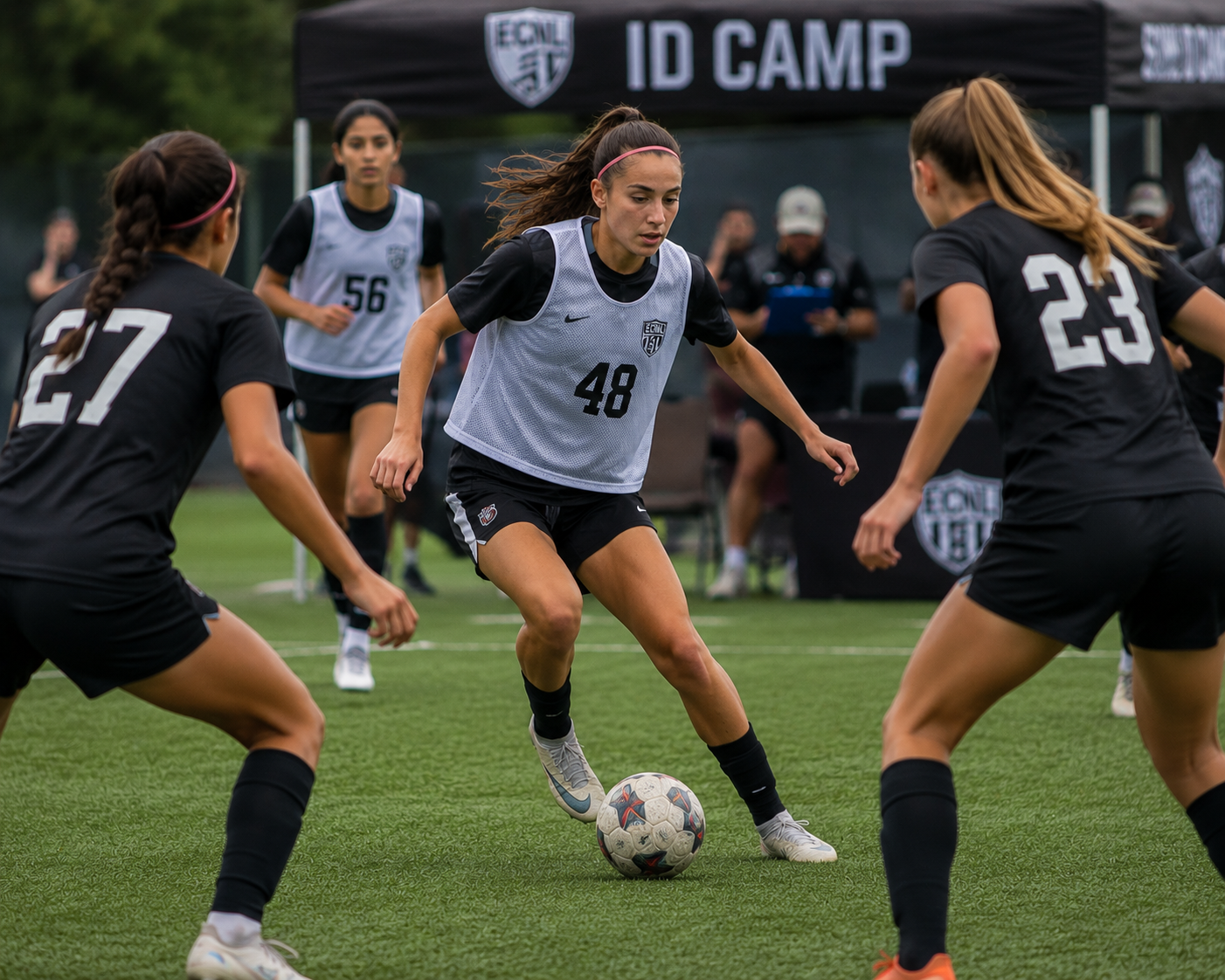
Girls soccer recruiting moves faster than most families realize. By the time a family decides it is time to start the process, the athletes who understood the timeline are already ahead. This is not meant to create panic. It is meant to create a plan.
This article covers the girls soccer recruiting timeline specifically — the sport, the leagues, the showcases, and the moments that matter most. For the full phase-by-phase recruiting framework, the D1ProjX Blueprint covers every step in detail. This is the soccer-specific map.
The Role of Club Soccer — League and Team Both Matter
Before the timeline, families need to understand something about how college coaches evaluate girls soccer players. They look at league first, then team.
No coach will say this out loud. But it is how the evaluation process works — the same way any person makes an immediate assumption based on context before they know the details.
ECNL — the Elite Clubs National League — is the top girls club soccer league in the country. Based on available data, ECNL produces over 60 percent of D1 college soccer players, and the percentage is likely higher for Power Four programs. When a coach sees ECNL on a player’s profile, they know the level of competition she has been tested against. That context matters before they ever watch a single clip of film.
GA — Girls Academy — is the next tier, roughly alongside the ECRL. A top GA team absolutely gets college coaches watching. The league is competitive and produces D1 players consistently. The team within the league matters enormously at this level — a player on a nationally recognized GA program will get more coach attention than a player on a mid-level GA team.
Regional and local club leagues produce D1 players too. But the path is harder and the visibility is lower. If it is possible for your athlete to move to a higher league and the level of play supports it, the exposure difference at ECNL showcases alone makes it worth considering. That said, the outreach system, the highlight reel strategy, and the Blueprint framework that you find on D1ProjX can get coaches to your games and get their attention regardless of league. The system works. The league amplifies it.
One note on ECNL specifically. The showcase attendance that league generates is unmatched. No other girls soccer league brings the volume of college coaches to their events that ECNL does. That visibility is a real and significant advantage for players in that league.
8th Grade and Earlier — Earlier Than You Think
Girls soccer recruiting starts early. Earlier than any other sport most families have experience with. Pre-ECNL and ECNL clubs are identifying players at U10, U11, U12. Joining a competitive club early — even if your athlete is an outsider at first — puts her in the right environment to develop and be seen.
If your athlete is already in middle school and on a competitive club team, the foundation is being built whether you realize it or not. Pay attention to which college coaches are at showcases. Start building awareness of programs that recruit from your league and region.
9th Grade — The Foundation Year
Freshman year is when the recruiting process officially starts for the family, even if the athletic development has been happening for years. This is the year to research programs, begin building a school list, and establish the academic baseline. GPA matters from day one. Coaches look at transcripts.
Get a highlight reel up. Even a basic one. It does not need to be perfect. It needs to exist and it needs to show the right position-specific moments. The RISE highlight reel editor is free and built specifically for recruiting. Fill out questionnaires on the websites of every program on your list. Attend showcases where college coaches are present and watching.
No coach is offering a freshman. But coaches are absolutely identifying freshmen they want to track over the next three years. Be on the list. The full Phase 1 framework is at d1projx.com/blueprint/phase-1.
10th Grade — Make Contact and Be Seen
Sophomore year is when outreach begins in earnest. Email college coaches directly. Send your highlight reel. Fill out every program questionnaire on your list. No D1 coaching staff member — head coach, associate coach, or recruiting coordinator — can initiate contact with your athlete before June 15 of sophomore year. That does not mean they are not reading your emails and watching your film. They are. The families who have been in coaches’ inboxes for months before June 15 are the ones who generate contact the moment the rules allow it.
Build the school list to 75 to 100 programs. Start identifying recruiting coordinators and associate coaches at each program. Once the contact window opens on June 15, they manage the pipeline and often engage before the head coach does. Reach out to all of them — not just the head coach.
For girls soccer, sophomore year showcase season is critical. ECNL showcase events in warm weather locations produce the highest college coach attendance. Jefferson Cup is one of the best opportunities available to clubs at every level — it is open to all clubs and draws serious college coach attention. PDA events are also strong. Avoid reading too much into attendance at cold weather events — a December showcase in the Midwest in freezing temperatures does not bring out the same coaching staff presence as a Florida event in February. That is not a reflection of your athlete. It is a reflection of conditions.
The full Phase 2 framework is at d1projx.com/blueprint/phase-2.
The Move That Almost No Family Makes: The night before June 15 — email every coach on your list. A brief, professional message. Tell them you are looking forward to the contact window opening tomorrow and that you remain genuinely interested in the program. A coach in the Patriot League reached out on June 15 and said: “What a great move emailing yesterday. Who told you to do that?” The full breakdown is in our article What Athletes Must Do on June 14th.
11th Grade — The Most Important Year
Junior year is where recruiting either gains real momentum or stalls. Coaches are making decisions about their next recruiting class. Campus visits are happening. Conversations are becoming specific.
Pay attention to conference patterns. When multiple programs in the same conference show genuine interest in your athlete, that is a signal worth reading. It tells you something real about where your athlete’s level fits in the college soccer landscape. The market is speaking. Listen to it.
If your athlete committed verbally before junior year, the process worked exactly as it was designed to. Early commitment comes from early preparation. Every phase before it made that moment possible.
This is also the year families feel the most pressure. That pressure is real but manageable with the right process. Stay systematic. Keep communicating. Make Them Tell You No. The full Phase 3 framework is at d1projx.com/blueprint/phase-3.
11th Grade — If There Is No Offer Yet
If your athlete is a junior and does not have an offer yet, this is the moment for honest evaluation — not panic. No offer does not mean no interest. It does not mean the process is failing. It means the next move matters more than any move made before it.
Start by looking at the school list. Are the programs on it realistic fits for your athlete’s current level — athletically and academically? This is the year to add programs, not protect a list that is not producing results. Expand the geographic range.
Update the highlight reel. Junior year film is the most relevant film a coach can watch. If the reel is from sophomore year it is already working against your athlete. Get new film up immediately using the free RISE editor.
Increase outreach volume and target the recruiting coordinator at every program on the expanded list. Follow up on every school where any conversation has started — even a brief one. Coaches who have responded at any point are warmer than coaches who have never heard from your athlete. Work those relationships first.
Keep going to showcases where college coaches are present and watching. Junior year showcase exposure is some of the most valuable evaluation time in the entire process. Be there. Be fit. Be visible.
The offer will come to the athlete who keeps working the process. The full Phase 3.5 framework — built specifically for this moment — is at d1projx.com/blueprint/phase-35.
12th Grade — Close It
Senior year is decision time. Offers are on the table. Official visits are happening. The National Letter of Intent signing periods open. Families are evaluating fit — academic, athletic, financial, and geographic.
The athletes who did the work in 9th through 11th grade have options. The athletes who did not are scrambling. That difference was built over three years of process — not in senior year.
If your athlete is a senior still pursuing a D1 offer, the process is not over. Use every resource available. Follow recruiting accounts on X and Instagram that post commitment announcements — those posts tell you in real time which programs are still actively filling spots. Use SoccerWire and TopDrawerSoccer to track commits by program and identify which rosters still have room. The RISE highlight reel editor is one of the most important tools at this stage — a current, well-built reel sent to programs with open spots is the fastest way to get in front of coaching staffs who are still actively recruiting.
The full Phase 4 and Phase 5 frameworks are at d1projx.com/blueprint.
The D1ProjX Blueprint
Free. Complete. Built on This Exact Process.
Four full D1 scholarships. One system. The Blueprint covers every phase of girls soccer recruiting from 9th grade to signing day.
Get the Free Blueprint →NCAA contact rules referenced in this article apply to Division I women’s soccer as of the 2025–26 recruiting calendar. Rules are subject to change. Always verify current regulations at ncaa.org.